
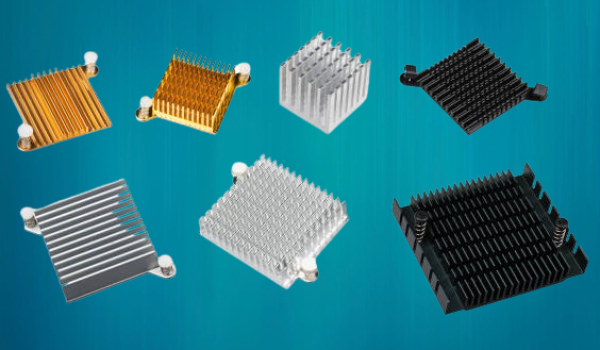
Nearly 40% of unexpected electronics failures trace back to overheating — a surprising scale that makes cooling choices critical for your projects.
A heat sink is a vital part of thermal management. It’s designed to pull heat away from electronic devices to maintain optimal performance and longevity. You’ll see two big categories: active options with fans or blowers, and passive options with no moving parts.
This guide previews practical comparisons you can use: airflow approach (passive, active, hybrid), material choice like aluminum or copper and advanced spreaders, liquid options, and manufacturing methods such as extruded, skived, stamped, forged, and CNC machined.
Match performance to constraints; choose by airflow, material, liquid use, and manufacturing for best fit.
How Heat Sinks Work and What Drives Thermal Performance
Understanding how a sink moves heat lets you compare designs and pick the right cooling path for your device. The basics are simple: heat leaves a component, travels through the sink material, and moves into the surrounding air or liquid. Base flatness, fin geometry, heat pipes, thermal interface material, and mounting pressure all change thermal performance. Ambient temperature, dust, and noise also limit results. Regular cleaning and correct TIM choice keep temperatures low.
Heat Transfer Basics
Conduction moves heat from the device into the base. Convection moves that energy from fins into air or coolant. Radiation usually plays a small role but can matter with high-emissivity surfaces.
Why Fins and Surface Area Matter
Fins increase surface area so more heat can leave the sink. But tighter fin spacing can block flow and reduce real-world dissipation. Good fin geometry balances area with airflow.
Airflow: Natural vs Forced Convection
Natural convection depends on orientation and temperature difference. Forced convection — using fans or pumps— gives predictable cooling if airflow and ducting are designed well.
Key Components and Real Constraints
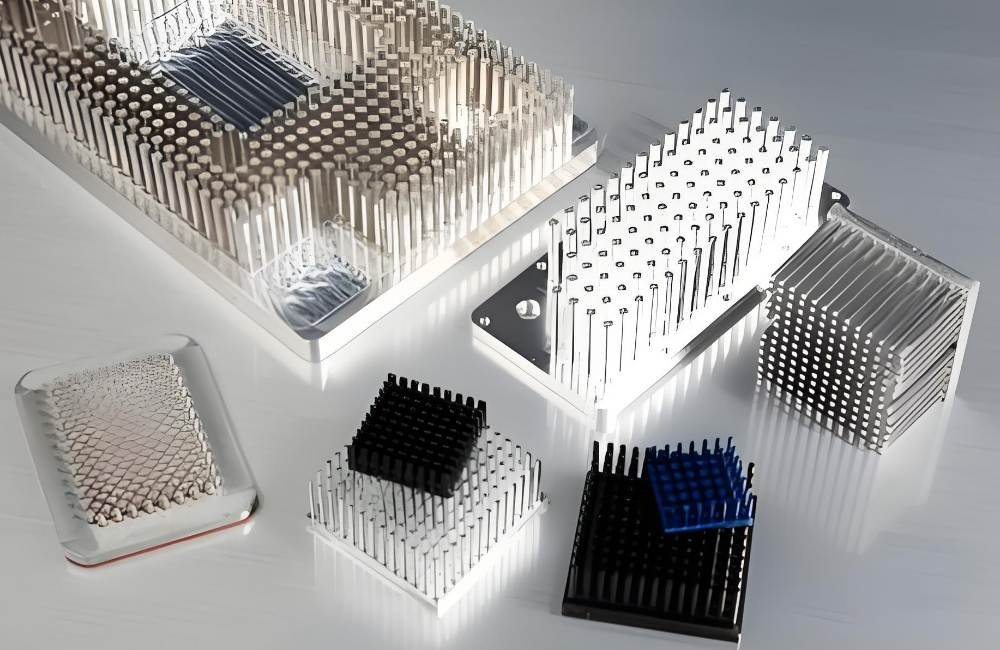
Base flatness, fin geometry, heat pipes, thermal interface material, and mounting pressure all change thermal performance. Ambient temperature, dust, and noise also limit results. Regular cleaning and correct TIM choice keep temperatures low.
Heat Sinks by Airflow
Passive Heat Sink
A passive heat sink relies on natural convection to transfer heat from the device to the surrounding air. Since it has no moving parts, it’s more reliable and doesn’t require external power. They are simple, durable, and silent, so you avoid fan wear and extra maintenance.
Passive heat sinks are used in low power applications and often serve as a dual purpose device enclosure. An example is a metal casing that’s both the structural housing and heat dissipating component. Also, passive heat sinks are used for moderate loads: low-power processors, many LED fixtures, and enclosures with steady air paths.
Active Heat Sink
An active heat sink has additional cooling mechanisms like fans, blowers, or liquid cooling systems. These heat sinks increase heat dissipation efficiency by forcing air or liquid over the heat exchanger. They increase heat transfer and let you use tighter fin stacks in small packages.
While active heat sinks perform better, they require external power, making them less reliable than passive solutions. You can expect higher cooling capacity but more noise, power draw, and cleaning to control dust buildup. Active heat sinks are used in high performance computing, industrial equipment and applications that require high cooling capacity.
Heat Sinks by Material
Aluminum Heat Sink
Aluminum is the most widely used material for heat sinks because it’s lightweight, affordable and easy to manufacture. That makes aluminum heat sinks the go-to for many electronic devices where weight and cost matter. Common aluminum alloys for heat sinks production can be machined through different grades of aluminum. are:
- 6061 and 6063 – Balances strength and thermal conductivity.
- 1050 and 1100 – Higher purity and better thermal performance. Although aluminum has moderate thermal conductivity, it may not be suitable for applications that require high heat transfer rates.
Copper Heat Sink
Copper is a better heat conductor with thermal conductivity of around 400 W/m-K, much better than aluminum, so it limits hotspots and improves transfer into the fin field, making it ideal for high performance cooling applications.
However, copper is heavier and more expensive than aluminum, limiting its use in applications where weight and cost are a concern. It’s best when you need extra thermal margin. Copper heat sinks are used in data centers, industrial machinery and critical cooling systems.
Hybrid (Copper-Aluminum) Heat Sink
Alloying aluminum boosts strength and machinability but can lower raw conductivity. A hybrid heat sink has a copper base with aluminum fins to balance performance, weight and cost. The copper base extracts heat from the source while the aluminum fins dissipate heat. This design is used in electronics cooling where moderate cost and high performance are required.
Advanced Spreaders for Tight Form Factors
Engineered graphite spreads heat across thin surfaces with low mass, while diamond offers extreme conductivity for niche semiconductors and lasers. Use these when spreading beats simply adding fin area.
Heat Sinks by Use of Water
Solid Metal Heat Sink
Solid metal heat sinks are the most common type, consisting of a solid metal base and an array of fins that dissipate heat into the air. These heat sinks are made from aluminum or copper and are a cost effective cooling solution for various electronics. Its simplicity and durability make it the most widely used heat sink type in consumer electronics and industrial applications.
Pumped Liquid Heat Sink
Pumped liquid heat sinks use a coolant circulated through a cold plate attached to the heat source. The liquid absorbs heat and carries it away to a separate heat exchanger where it’s dissipated. While highly effective, this method introduces additional components like pumps and tubing, reducing overall reliability.
Pumped liquid cooling is used in high performance computing, medical devices, and industrial applications where extreme heat loads need to be managed.
Two-Phase Heat Sink
Two-phase heat sinks have vapor chambers or heat pipes to enhance heat transfer. These devices use phase-change technology to move heat efficiently across a surface. Heat pipes transfer heat through a working fluid that evaporates and condenses cyclically, while vapor chambers spread heat uniformly across a large surface area.
Two-phase heat sinks are as reliable as solid metal designs but provide better cooling performance at a slightly higher cost.
Heat Sinks by Manufacturing Process
CNC Machined Heat Sink
CNC machined heat sinks allow for complex, high-precision designs with excellent thermal properties. However, this manufacturing process is expensive and time-consuming, making it unsuitable for mass production. CNC machined heat sinks are used in custom applications where performance and precision outweigh cost considerations.
Forged & Die Cast Heat Sink
Forged and die-cast heat sinks are cost effective solutions for high volume production. Forging allows intricate heat sink designs, while die-casting is ideal for thick fins used in natural convection applications. However, both require significant upfront tooling cost, making it more suitable for large scale manufacturing.
Zipper Fin Heat Sink.
Zipper fin heat sinks have thin, densely packed fins for high performance. They are often used with heat pipes or vapor chambers to maximize heat dissipation. A good balance of performance and cost makes them suitable for mid-to-high performance applications.
Skived Fin Heat Sink
Skived fin heat sinks have thin, high-aspect-ratio fins carved directly from a solid metal block for high performance. This method allows for tight fin packing without additional bonding or assembly. While skived heat sinks are efficient, the fins can be fragile and prone to bending.
Bonded Fin Heat Sink
Bonded fin heat sinks are for large cooling applications where maximum heat dissipation is required. This method allows for different materials for base and fins, offering design flexibility. Bonded fin heat sinks are used in power electronics and industrial cooling systems.
Extruded Heat Sink
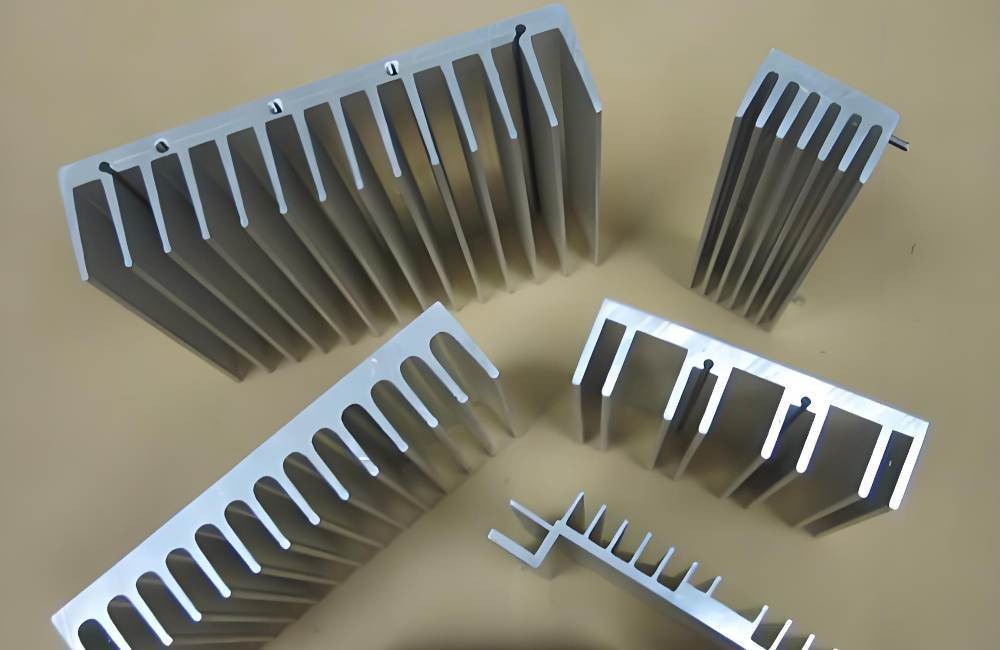
Extruded heat sinks are the most cost-effective option. They are produced by forcing aluminum through a die to create a continuous shape which is then cut to size. While extrusion limits design flexibility, secondary machining can enhance performance. Extruded heat sinks are used in consumer electronics and moderate performance applications.
Conclusion
Choosing a heat sink involves considering performance, material, cost and application requirements. A practical cooling choice balances target temperature, noise limits, and maintenance needs for predictable results.
Start by quantifying heat load and allowed temperature rise. Then pick an airflow plan — passive for quiet, active for higher capacity, or hybrid for variable loads.
Choose materials next: aluminum for weight and cost, copper where thermal conductivity and hotspot control matter, and advanced spreaders for thin or extreme designs.
Match manufacturing process to budget and geometry: extruded for low cost, bonded or skived for large or high‑density fins, forged or CNC when specific shapes are required.
For CPUs, servers, and tight enclosures, prefer active or liquid cooling; for many LEDs and power electronics, passive or hybrid solutions often work well.
Let’s Start Your Custom Heat Sink Project
At Fecision, we provide precision machining services for custom heat sinks, delivering tight tolerances, excellent thermal performance, and material options tailored to your specific application. Whether you need prototypes or large-scale production, our advanced manufacturing capabilities ensure heat sinks that meet your exact thermal and mechanical requirements.
Partner with Fecision today to create high-performance, custom-machined heat sinks designed for superior cooling efficiency.