Do you really know which choice will save time, money, and headaches when you specify parts or packaging?
This brief comparison lays out what each polymer is and why that matters for your design. You’ll get plain definitions, then a clear look at strength, toughness, cost, and recyclability.
One option is a high-crystallinity thermoplastic made from petroleum byproducts that delivers density and load resistance. The other is a terpolymer with acrylonitrile for chemical resistance, styrene for surface finish, and butadiene for impact toughness.
We’ll show how each material performs in real products, from bottles and tanks to automotive parts and consumer goods, so you can match performance to your timeline and budget. By the end, you’ll know which tests—temperature, UV, chemicals, or impact—matter most to meet your needs.
What Is HDPE?
A smart material choice starts with clear facts about composition and behavior. High-density polyethylene is a higher-molecular-weight form of polyethylene with very low side-branching. Its long chains pack tightly and create ordered, pseudo-crystalline regions that raise density and strength.
Key characteristics
That tight packing yields density in the range of about 0.933–1.27 g/cm3. The result is improved stiffness, load-distortion resistance, and toughness, while elasticity falls compared with lower-density grades.
Typical melt behavior sits near 120–130 °C, and service temperatures commonly range from roughly 80 to 120 °C depending on grade. These characteristics make the material predictable in injection, blow, and extrusion processes.
Common products and applications
You’ll find hdpe in bottles, caps, containers, pipes, tanks, crates, and playground equipment. Its excellent chemical resistance and low moisture uptake suit water handling, fuel cans, and storage drums.
Recycled streams are widely available, which can lower cost and support sustainability goals. For many projects, these properties balance performance, durability, and price effectively.
What Is ABS?
ABS is a go-to engineering plastic when you need a balance of cosmetic finish and toughness. It’s a terpolymer made by combining styrene and acrylonitrile with dispersed butadiene rubber.
Inside acrylonitrile butadiene styrene: composition and how each monomer contributes
Typical formulations contain about 15–35% acrylonitrile, 5–30% butadiene, and the remainder styrene. Acrylonitrile raises chemical resistance, rigidity, and higher service temperature.
Styrene gives a smooth surface, hardness, and good melt flow for processing. Butadiene adds impact toughness and low-temperature ductility, making the overall properties more durable in use.
Where you see ABS: consumer enclosures, automotive parts, appliances, and toys
You’ll find this material in housings and covers for appliances, electronics, and instrumentation because it molds well and looks premium. Automotive interior trims, panels, and some exterior components rely on its dimensional stability and impact performance.
Toys, like precision-molded bricks, use this plastic for detail, color consistency, and perceived strength. If you need higher strength or heat resistance, consider ABS blends (for example, with polycarbonate) or modified grades to meet tougher applications.
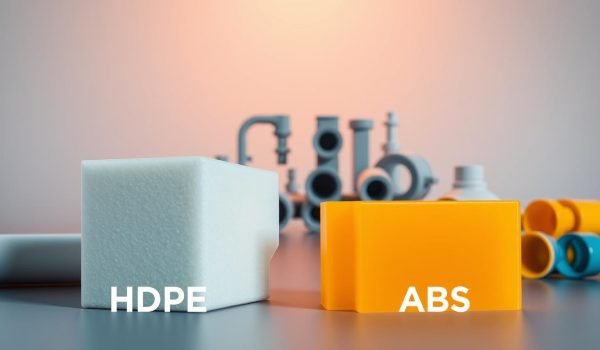
HDPE vs ABS: Main Differences
Choosing the right polymer changes how your part performs in real use. This quick comparison highlights the core properties you’ll weigh when selecting materials for manufacturing and applications.
Physical properties
Semi-crystalline grades show higher toughness and better stress-crack resistance, while amorphous grades deliver smoother finishes and tighter dimensional control. Density ranges overlap (about 0.93–1.27 g/cm3 versus 1.0–1.2 g/cm3), and tensile modulus is generally higher for the amorphous option (roughly 1–2.65 GPa) than the semi-crystalline choice (0.48–1.45 GPa).
Manufacturing method
One material is common in blow molding and extrusion for bottles, pipes, and tanks. The other excels in injection molding for detailed, cosmetic parts and panels. Choose based on part size, finish requirements, and cycle time.
Applications, cost, and sustainability
For containers, outdoor furniture, and heavy-duty piping, chemical resistance and impact absorption matter most. For housings, trim, and precision enclosures, rigidity and surface finish dominate.
Price for commodity grades overlaps, but recycled options lower the cost more for the semi-crystalline stream. Both plastics can be recycled; one has more robust collection routes, while the other’s recyclate often comes from large consumer and automotive parts.
Performance in real-world conditions
Outdoor exposure, thermal swings, and solvent contact change how materials behave in service. You need to match properties to the conditions you expect so parts last and perform.
Outdoor and UV exposure
For playground equipment and outdoor furniture, one material is often chosen because it resists water and many chemicals and stays tough over years. UV stabilizers or pigmented grades reduce weathering and retain color and strength.
The other material appears on vehicle trims and some exterior housings. It can be used outside but needs UV-stabilized or painted grades to avoid discoloration and embrittlement over long sun exposure.
Temperature and impact
Under heat and cycling, the first material keeps toughness across a broad range and typically serves up to about 80–120 °C depending on grade. It also resists low-temperature cracking and holds up under repeated impact.
The second keeps a crisp surface and dimensional stability up to roughly 80–100 °C. Butadiene content helps low-temp impact resistance; some grades may still become brittle in extreme cold.
Chemical resistance and pressure
When you need containers, fuel tanks, or piping that see detergents, fuels, or solvents, the first material is usually the safer choice due to strong chemical resistance and low water uptake.
Consider creep and pressure behavior for piping and load-bearing parts; design for long-term stress and test compatibility before scaling up. Always run compatibility checks for harsh chemicals since stress-crack risks vary by reagent and grade.
Manufacturing and design considerations
The way you manufacture a component directly affects fit, finish, and unit economics. Choose methods that match your design intent early to avoid rework and delays.
Injection molding, blow molding, and extrusion: part size, finish, and throughput
For large hollow parts or bottles, blow molding gives high throughput and low unit cost. Extrusion works well for pipes and long profiles that need chemical resistance and flexibility.
Injection molding supports detailed parts and tight tolerances. If you need premium textures or thin walls, injection is usually the best production route.
3D printing and thermoforming: when FDM or forming makes sense
Use FDM for quick prototypes and small production runs. ABS-based filaments often post-process cleanly and withstand functional tests better than many beginner plastics.
Thermoforming suits large cosmetic panels from sheet. It favors materials that form with crisp draws and a smooth finish; some semi-crystalline sheets are better for utility panels where toughness matters.
CNC machining and assembly: tolerances, bonding, and finishing options
CNC machining gives precise components and is useful for low-volume parts or tooling. ABS machines with clean edges; more ductile sheets require adjusted feeds to avoid burring.
For assembly, expect easier bonding and painting with styrenic materials, while the semi-crystalline stream needs mechanical fastening or special surface prep. Plan tolerances and finishing early to control cost and cycle time.
HDPE vs. ABS: Which Material Should You Choose
Your material choice should begin with a simple question: which property will make the product succeed? Decide by weighing environment, finish, and budget against manufacturing needs.
If you prioritize chemical resistance, weight, and cost
Choose high-density polyethylene when chemical resistance and rugged durability are top priorities. It suits containers, pipes, tanks, and playground equipment that face detergents, fuels, or moisture.
Recycled polyethylene can cut resin price and lower unit cost for high-volume runs. That makes it a strong pick when your product must be durable and inexpensive.
If you need rigidity, cosmetic finish, and precise detailing
Pick abs when rigidity, tight tolerances, and a glossy surface matter. It works well for enclosures, dashboards, and consumer products that require a premium look.
If you need extra strength without changing families, consider ABS‑PC blends to boost strength by about 15–25% while retaining processing ease.
Industry scenarios: packaging, automotive, consumer electronics, and architecture
For packaging, polyethylene wins for bottles and containers where cost and resistance matter. In automotive and consumer electronics, abs gives better rigidity and cosmetic appeal.
Align your selection to product needs: choose for resistance and low price when ruggedness rules; choose for stiffness and finish when perception and fit matter. Test both materials for hybrid requirements before scaling.
Conclusion
Start by mapping the loads, chemicals, and finish your part will face. High-density polyethylene has long, tightly packed chains that give density, toughness, and strong chemical resistance for containers, bottles, pipes, tanks, and playground equipment.
Acrylonitrile butadiene styrene combines acrylonitrile, styrene, and butadiene to deliver rigidity, a smooth surface, and impact toughness for toys, housings, and automotive panels. Manufacturing favors blow molding and extrusion for the first and injection molding for the second.
Cost and recyclability overlap, but recycled polyethylene often yields deeper savings while ABS recyclate is usually blended. If you still face mixed conditions, prototype both materials and test under your actual service conditions before locking your choice.