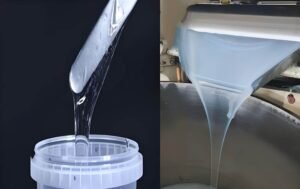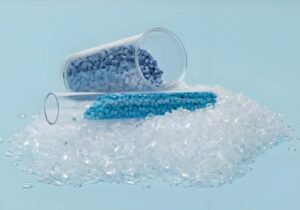
| PE injection molding is the process of melting polyethylene resin and injecting it into a steel mold under pressure. Three grades dominate production: HDPE (rigid, structural, high crystallinity 70–80%), LDPE (flexible, transparent, easy-fill), and LLDPE (strong, puncture-resistant, higher melt viscosity than the other two). Each grade requires different barrel temperatures, mold temperatures, and shrinkage compensation. |
Polyethylene is the world’s most-produced plastic by volume. Its dominance comes from a combination of low cost, chemical resistance, ease of processing, and a property range that — across its three main injection-moldable grades — covers almost every flexibility and rigidity requirement in consumer goods, packaging, and industrial components.
The distinct qualities of HDPE, LDPE, and LLDPE impact the performance of your products. To assist you in making an informed decision, this guide outlines the procedure, material characteristics, and actual applications.
Why Polyethylene Dominates Injection Molding
Polyethylene is a semi-crystalline polymer with a backbone of repeating –(CH₂–CH₂)– units. The degree of branching in the polymer chain determines the grade’s crystallinity, density, and mechanical properties. Understanding the structure explains why the three grades behave so differently in the mold.
PE has several processing advantages that make it straightforward to work with despite the shrinkage challenge:
- No pre-drying required: Unlike nylon or PET, polyethylene absorbs negligible moisture. Parts can move directly from storage to the barrel without a drying step — simplifying production scheduling.
- Wide processing window: PE’s thermal stability means temperature fluctuations within the normal processing range do not cause significant degradation or property changes. Decomposition below 300°C is minimal.
- Good mould release: PE parts demould readily. Shallow undercuts can often be force-ejected without side actions, because the material’s flexibility allows slight deformation during ejection.
- Low cost at high volume: Raw material cost is among the lowest of all injection-moldable engineering polymers. Combined with fast cycle times for thin-walled parts, PE is a highly economical choice at scale.
The main limitation to manage: shrinkage. PE’s semi-crystalline structure means it undergoes significant volume reduction as crystalline domains form during cooling. Shrinkage is not only higher than amorphous plastics like ABS or PC — it is directional, which makes mold design and cooling circuit layout more critical than with simpler materials.
Basics Of PE Injection Molding
Resin pellets are the first step in PE injection molding. Heat is applied to these pellets until they melt. After that, high pressure is used to force the molten polyethylene into a steel mold. The shaped part is ejected when the mold opens after it has cooled.
Importance Of Precision:
Mold design, pressure, and heat are all important. You risk flaws such as warping, voids, or cracks if you lack sufficient control. Even small errors can impact the strength and appearance of your finished product.
Why does it matter to you?
This method simplifies mass production. Complex shapes can be produced rapidly, reliably, and affordably. You can ensure that your products meet quality standards and performance expectations by becoming an expert in these steps. For this reason, polyethylene injection molding is widely used for both industrial and consumer goods.
Material Properties Of Polyethylene
Polyethylene is renowned for its flexibility, toughness, and resistance to impacts. It is resistant to many solvents, chemicals, and moisture. Due to these characteristics, it can be utilized in demanding settings.
Thermal And Mechanical Behavior:
For the majority of uses, it stays stable but softens at moderate heat. You can choose between rigid and flexible options because their mechanical strength varies with density. One of the primary reasons polyethylene is utilized in numerous industries is its design flexibility.
Crystalline And Amorphous Aspects:
Polyethylene has a semi-crystalline structure. Whereas amorphous regions provide flexibility, crystalline regions provide strength. Performance can be altered by varying density. You can create better products that last longer in their intended use by being aware of these differences. Understanding the science underlying the material helps you make more informed manufacturing decisions.
HDPE Injection Molding
High-density polyethylene has minimal chain branching, which allows its polymer chains to pack tightly. This produces a crystallinity of 70–80% — the highest of the three grades — and gives HDPE its characteristic stiffness, high tensile strength, and excellent chemical resistance.
HDPE Material Properties at a Glance
Density: 0.941–0.965 g/cm³. Tensile strength: 20–40 MPa. Flexural modulus: 800–1,500 MPa. Service temperature: −50°C to +120°C. Chemical resistance: excellent against most acids, alkalis, and solvents.
HDPE Processing Behaviour
HDPE’s high crystallinity is both its strength and its main processing challenge. Crystallisation during cooling releases latent heat, which means HDPE requires more aggressive cooling than LDPE and is more sensitive to cooling imbalances that create differential shrinkage and warpage.
Mold temperature is the primary variable: higher mold temperatures produce greater crystallinity, higher part stiffness, and more shrinkage. Lower mold temperatures reduce crystallinity and shrinkage but produce softer, less dimensionally stable parts. For most production applications, mold temperatures of 40–65°C balance crystallinity and shrinkage acceptably.
Gate selection is particularly important for HDPE. Direct sprue gates are a common source of warpage — the high stress concentration at the gate, combined with HDPE’s strong directional shrinkage, causes flat parts to bow. Fan gates and pin gates positioned away from critical dimensions are the standard solution.
HDPE Applications
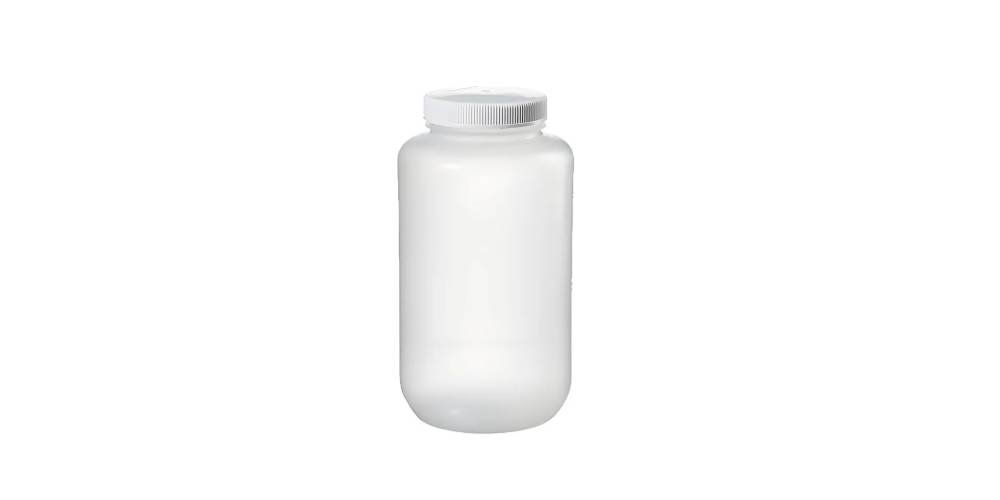
- Rigid containers and bottles: The material’s excellent chemical resistance and rigidity make it the standard for industrial chemical containers, food packaging, and household product bottles.
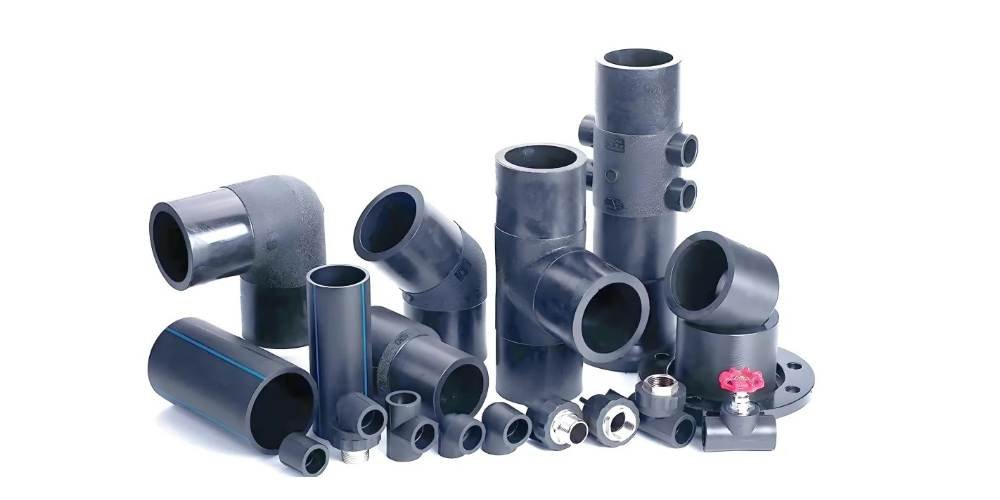
- Pipes and fittings: HDPE pipe fittings are injection molded and field-joined to extruded HDPE pipe in water supply, gas distribution, and industrial fluid systems.
- Industrial crates and pallets: Load-bearing, stackable storage and transport containers benefit from HDPE’s high flexural modulus and impact resistance.
- Automotive fuel system components: HDPE’s resistance to fuels, oils, and environmental UV exposure makes it suitable for fuel tanks, pump housings, and under-hood protective components.
- Medical containers: FDA-approved HDPE grades are used for sterile containers, sample storage, and laboratory consumables. See .
LDPE Injection Molding
Low-density polyethylene is produced by a high-pressure polymerisation process that creates substantial chain branching. This branching prevents tight chain packing, limiting crystallinity to roughly 45–55% and resulting in a lower density (0.910–0.930 g/cm³), greater flexibility, and translucency to near-transparency in thin sections.
LDPE Material Properties at a Glance
Density: 0.910–0.930 g/cm³. Tensile strength: 8–20 MPa. Flexural modulus: ~200 MPa. Elongation at break: 100–600%. Service temperature: −50°C to +80°C. Melt flow index: 0.3 to over 1,000 g/10min at 190°C (wide range of available grades).
LDPE Processing Behaviour
LDPE’s low melt viscosity makes it the easiest of the three PE grades to process. It fills complex mold geometries readily, handles thin-wall sections well, and responds to a wide range of processing conditions without significant quality penalties.
However, LDPE’s low stiffness means parts can deform under ejection force if too hot, and its relatively high shrinkage (up to 5% in some thin-wall applications) must be compensated in mold design. Overloading — applying excessive injection pressure — can cause flash at the parting line, because the low-viscosity melt penetrates even minor gaps.
Melt temperature for LDPE runs from 160°C to 260°C depending on the specific grade and MFI. The wide processing window reflects LDPE’s good thermal stability.
LDPE Applications
- Flexible packaging: Squeeze bottles, dispensing closures, and flexible container lids where repeat flexing without cracking is required.
- Medical and laboratory consumables: Flexible tubing, sample bags, and wash bottles. LDPE’s chemical resistance and FDA compliance cover most laboratory reagents.
- Consumer packaging closures: Pop-top caps, hinged lids, and flip closures benefit from LDPE’s living-hinge capability and repeated flex resistance.
- Agricultural films and components: Thin-wall irrigation fittings and flexible enclosure components.
Squeeze bottles, consumer packaging, and medical equipment frequently contain LDPE. When softness and transparency are crucial, it is the preferred option. LDPE is the best option if your product requires flexibility and ease of shaping. Many industries benefit from its rapid ability to mold into intricate shapes.
LLDPE Injection Molding
Linear low-density polyethylene is a copolymer of ethylene with short-chain alpha-olefin comonomers — typically butene-1, hexene-1, or octene-1. The short branches disrupt crystallisation, giving LLDPE properties between LDPE and HDPE: more flexible than HDPE, but with significantly better puncture and tear resistance than LDPE.
LLDPE Material Properties at a Glance
Density: 0.915–0.940 g/cm³. Tensile strength: 14–28 MPa. Flexural modulus: 200–400 MPa (lower than HDPE’s 800–1,500 MPa). Elongation at break: excellent. Impact resistance: best of the three PE grades. Service temperature: −50°C to +90°C.
LLDPE Processing Behaviour — The Key Difference
LLDPE’s most significant processing characteristic is its higher melt viscosity compared to both LDPE and HDPE. This counterintuitively makes LLDPE harder to process despite having lower stiffness than HDPE. In practice, it means: [4]
- Larger gates and runners required: Standard gate sizes for LDPE or HDPE will restrict flow and cause short shots or excessive shear in LLDPE. Runner and gate dimensions should be 20–30% larger than equivalent HDPE tooling as a starting point.
- Higher injection pressure: 10–15 MPa compared to 5.5–10 MPa for HDPE. Machine shot capacity should have adequate margin.
- Back-pressure sensitivity: LLDPE requires higher back-pressure settings than LDPE or HDPE to achieve a homogeneous melt. Insufficient back-pressure produces inconsistent fill and part weight variation.
- Blending advantage: LLDPE blends well with HDPE and LDPE, allowing manufacturers to tune flexibility, stiffness, and cost within a single mold by adjusting blend ratios without retooling.
LLDPE Applications
- Stretch and cling films: LLDPE dominates stretch film production because its high elongation and tear resistance outperform LDPE under rapid stretching.
- Heavy-duty bags and liners: Garbage liners, industrial liners, and construction film benefit from LLDPE’s puncture resistance.
- Agricultural films: Greenhouse covers and mulch films where UV-stabilised LLDPE provides long service life.
- Flexible injection molded parts: Flexible closures, hinge components, and snap-fit parts where repeated flex resistance is more important than optical clarity.
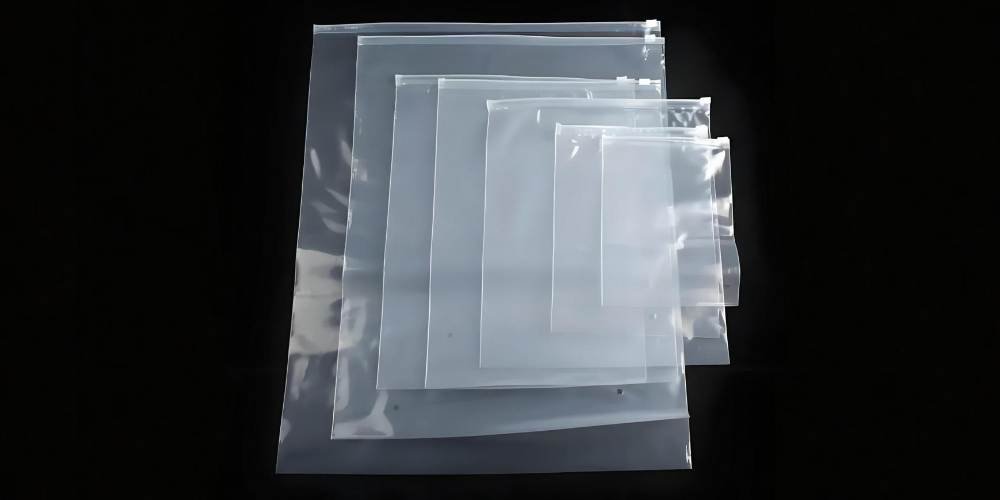
PE Injection Molding Processing Parameters
The table below provides typical parameter ranges for general-purpose injection molding grades of each PE type. Always verify against your specific grade’s datasheet, as additives — UV stabilisers, colorants, nucleating agents — can shift optimal settings significantly.
| Parameter | LDPE | HDPE | LLDPE |
| Barrel temperature | 140–200°C (rear lower, nozzle upper) | 180–230°C (tighter window than LDPE) | 180–230°C (higher back-pressure needed) |
| Mold temperature | 30–45°C (lower for faster cycle) | 40–65°C (higher = more crystallinity, more shrink) | 30–50°C |
| Injection pressure | Up to 15 MPa (low viscosity, easy fill) | 5.5–10 MPa (higher crystallinity, stiffer melt) | 10–15 MPa (higher viscosity than LDPE/HDPE) |
| Shrinkage | 1.5–5% (anisotropic — warpage risk) | 1.5–4% (higher than LDPE at same thickness) | 1.5–4% (similar to HDPE) |
| Back-pressure | Low (0.2–0.5 MPa) | Moderate (0.3–0.8 MPa) | Higher than HDPE/LDPE — needed for uniform melt |
| Pre-drying required? | No — PE absorbs very little moisture | No | No |
| Gate recommendation | Fan or pin gate — avoid direct sprue | Fan or pin gate — direct sprue increases warpage | Larger gates required — high melt viscosity |
| Wall thickness guidance | 0.8–4mm typical; thin walls benefit LDPE | 1.0–5mm; uniform walls critical to reduce warpage | 1.0–4mm; thin walls risk short shots |
| Important note on shrinkage measurement PE shrinkage is anisotropic — it differs between the flow direction and the transverse direction. Flow-direction shrinkage can be 30–50% higher than transverse shrinkage in the same part.This directional behaviour is the primary cause of warpage in flat PE parts. Mold designers must account for it by using balanced cooling circuits, symmetrical gating, and uniform wall thickness. Simply applying a single shrinkage percentage to all dimensions will produce out-of-tolerance parts on any non-trivial geometry. |
How to Choose Between HDPE, LDPE, and LLDPE
Most grade selection decisions come down to three criteria: required stiffness, required flexibility/elongation, and whether the part must maintain transparency. Use the table below as a first-pass filter.
| Requirement | LDPE | HDPE | LLDPE |
| Part needs to be rigid and load-bearing | ✗ Too soft | ✅ First choice | Possible (lower modulus) |
| Part needs to be flexible and squeezable | ✅ First choice | ✗ Too stiff | Good alternative |
| Part requires high puncture or tear resistance | Acceptable | Good | ✅ Best of the three |
| Part requires optical clarity / translucency | ✅ Good | ✗ Opaque | Acceptable |
| Part operates above 100°C continuously | ✗ Inadequate | ✅ Yes (to 120°C) | Marginal (to 90°C) |
| Chemical exposure to aggressive solvents | Acceptable | ✅ Best choice | Acceptable |
| Thin-wall (<1.5mm) complex geometry | ✅ Easy to fill | Possible | ⚠️ Larger gates required — check fill |
| FDA food contact required | ✅ Yes | ✅ Yes | Select FDA-grade only |
| Production volume is very high (>500k/year) | ✅ Low cost | ✅ Low cost | ✅ Low cost |
| Stretch film or packaging with high elongation | Possible | ✗ Too stiff | ✅ First choice |
When none of the three grades is an ideal single-material fit, blending is an option. LDPE/HDPE blends produce properties between the two pure grades. LLDPE/HDPE blends improve HDPE’s impact resistance without sacrificing as much stiffness as LDPE would. In both cases, blends must be tested — blend ratios are not linearly predictive for all mechanical properties.
DFM Rules for PE Injection Molded Parts
Wall Thickness
Uniform wall thickness is the most important PE design rule. PE’s high shrinkage means thick sections shrink more and pull thinner adjacent sections out of shape.
Target 1.5–3.0mm for most applications. Where thickness variation is unavoidable, taper transitions over a distance of at least 3× the thickness change — abrupt steps create internal stress concentrations and visible sink marks on the thicker section’s opposing face.
Gate Design and Placement
Avoid direct sprue gates for HDPE — they concentrate residual stress at the gate location and drive directional shrinkage in the part. Fan gates or multiple pin gates spread stress and allow more controlled fill.
For LLDPE, gate size is critical. Undersized gates create excessive shear heat, which degrades the material at the gate and causes splay or streaking on the visible surface. Gate diameter should be at least 0.8–1.0mm for thin-wall LLDPE parts, scaling with wall thickness.
Draft Angles and Ejection
PE is soft enough that shallow undercuts can be force-ejected — a draft angle of 0.5–1.0° is typically sufficient for most PE parts with SPI B-grade or rougher surface finish. Very smooth surface finishes (SPI A-grade, Ra < 0.4µm) require 1.5–2.0° draft to prevent vacuum adhesion during ejection.
Cooling Circuit Design
Because PE’s shrinkage is so sensitive to cooling uniformity, cooling circuit design should aim for ±5°C maximum temperature variation across the cavity surface. Uneven cooling causes one side of a flat part to shrink more than the other — producing a curved or bowed part that cannot be corrected by adjusting injection parameters alone.
For HDPE parts with large flat areas, conformal cooling or turbulence-enhancing spiral inserts in cooling channels can significantly reduce the bowing that standard straight-drilled circuits produce.
Common PE Injection Molding Defects and How to Fix Them
Most PE defects trace back to three root causes: shrinkage not compensated in mold design, gate design not matched to the grade’s viscosity profile, or cooling imbalance. The table below maps the six most common defects to their specific root causes and corrections.
| Defect | Most Affected Grade | Root Cause | Corrective Action |
| Warpage / bowing | HDPE (primarily) | High crystallinity + anisotropic shrinkage. Direct sprue gate amplifies directional stress. Uneven cooling. | Switch to fan/pin gate. Balance cooling channels. Reduce mold temp gradient. Increase wall uniformity. |
| Sink marks | All grades | Insufficient packing pressure or packing time. Thick sections cool slower than surrounding walls. | Increase packing pressure and time. Reduce wall thickness variation. Locate gate near thickest section. |
| Short shots | LLDPE primarily | High melt viscosity of LLDPE limits flow length. Gates and runners too small for the material’s viscous melt. | Enlarge gates and runners. Increase injection pressure and melt temperature (up to limit). Check venting. |
| Surface splay / streaks | All grades | Moisture on material (rare for PE — more often contamination). Shear overheating from high injection speed. | Verify barrel and nozzle temperatures. Reduce injection speed. Check for material contamination. |
| Flash | LDPE primarily | LDPE’s low viscosity allows melt to penetrate even small parting line gaps. Excessive injection pressure. | Reduce injection pressure. Check parting line fit. Verify clamp tonnage (minimum 2–3 tons/cm² projected area). |
| Delamination / peeling | All grades | Contamination of PE melt with incompatible resin (common when purging from other materials). Thermal degradation. | Thorough purge between materials. Check barrel for dead zones. Reduce residence time. |
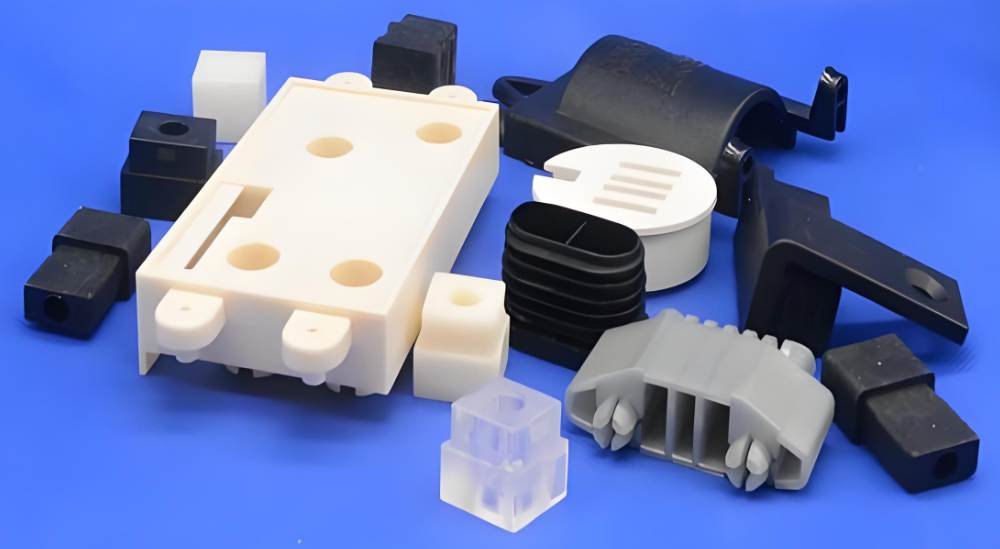
PE Injection Molding Applications Across Industries
Packaging
Packaging is the largest end-use sector for PE injection molding. LDPE handles flexible closures, squeeze dispensers, and thin-wall containers. HDPE handles rigid bottles, caps, and crates. FDA-compliant grades of both are available for direct food contact.
At high volumes — 500,000+ parts per year — PE’s fast cycle times and low material cost typically deliver the lowest total cost of any injection-moldable material for packaging applications. See Fecision’s for capacity and tooling details.
Industrial and Construction
HDPE’s resistance to aggressive chemicals, UV exposure, and mechanical fatigue makes it the go-to material for fluid-handling fittings, pipe components, and storage containers in chemical processing, water treatment, and agriculture.
Critical dimensional requirements — for components that must seal or thread into existing systems — should specify H13 or S136 steel tooling for molds, given HDPE’s higher crystallinity-driven shrinkage. See .
Medical and Healthcare
FDA-approved HDPE and LDPE grades are used for laboratory consumables, sterile packaging, sample containers, and non-implantable medical device components. Key requirements: virgin material (no regrind), lot traceability, and documentation under an ISO 13485 quality system.
UHMWPE (ultra-high molecular weight PE) is used for orthopaedic implants and bearing surfaces in medical devices — a specialised grade that is not injection moldable in the conventional sense and requires compression sintering, similar to PTFE.
Consumer Goods
LDPE’s optical clarity and flexibility make it a natural material for consumer product closures, dispensing mechanisms, and flexible components. HDPE’s rigidity and colour availability cover outdoor furniture, toys, and household storage products.
Frequently Asked Questions
What is the difference between HDPE, LDPE, and LLDPE?
The difference is in polymer chain architecture.
- HDPE has linear chains with minimal branching, producing high crystallinity (70–80%), stiffness, and chemical resistance.
- LDPE has heavy chain branching from its high-pressure synthesis, producing lower crystallinity (~45–55%), flexibility, and near-transparency.
- LLDPE is a copolymer with controlled short branches that deliver impact and tear resistance between the other two grades — but with a notably higher melt viscosity that affects gate and runner design.
Why does HDPE warp more than LDPE?
HDPE’s higher crystallinity (70–80% vs 45–55% for LDPE) means it undergoes a larger volume change during crystallisation as it cools. [2] This shrinkage is also more strongly directional — greater in the flow direction than transverse — creating differential shrinkage in flat or asymmetric parts that manifests as warpage.
Can LLDPE be used instead of LDPE in an existing mold?
In principle, yes — LLDPE is dimensionally similar to LDPE. In practice, the switch requires checking gate and runner dimensions. LLDPE’s higher melt viscosity means it may not fill the same mold at the same injection pressure as LDPE. If the existing tool has small gates designed for LDPE’s easy flow, expect short shots or surface defects when running LLDPE. Enlarging gates is often necessary.
What is the best PE grade for thin-wall packaging?
For thin-wall containers requiring flexibility and some transparency: LDPE. For thin-wall containers requiring rigidity and chemical resistance: HDPE. For applications requiring high elongation and puncture resistance (stretch wrap, heavy-duty bags): LLDPE.
Conclusion
PE injection molding covers a wider performance range than any other single polymer family available at comparable cost. The three grades address distinct application spaces: HDPE for structural rigidity and chemical resistance, LDPE for flexibility and optical clarity, LLDPE for impact and puncture resistance where LDPE is too weak and HDPE is too stiff.
The technical keys to consistent PE production are shrinkage management (anisotropic, higher than most polymers), gate design (direct sprue gates drive warpage in HDPE), and cooling uniformity (the primary control variable for dimensional stability in any PE grade).
Fecision provides DFM review as standard with all injection molding or tooling quotations. For PE parts with dimensional requirements, submit a drawing at fecision.com/contact-us